
How to Choose the Right Salon Management Software in 2026
If you own a salon in 2026, your software is no longer “just” a calendar and a cash drawer. It is the system that controls how clients find you, how they book, how your team works, and how you track whether any of it is actually profitable.
The stakes are high:
- The global salon services market is worth about $247 billion in 2024 and is projected to reach roughly $448 billion by 2032.
- Spa and salon software is growing fast; one analysis values the market at about $1.01 billion in 2025, projected to reach $1.69 billion by 2030, a compound annual growth rate near 11%.
In other words, there is a lot of money flowing through salon chairs and a lot of competing software trying to run it. The challenge is not “Should I use salon management software?” anymore. It is “Which system will actually help my business grow, instead of just adding another bill?”
This guide is designed to help you answer that question clearly before you sign a contract or move your data.
Step 1: Start With Outcomes, Not Features
Most owners start shopping the wrong way. They compare feature tables, listen to sales demos, and end up with a list of functions they may or may not use.
A better approach is to start by writing down the business results you want from your software in 2026. For example:
- “Increase online bookings so fewer clients have to call the front desk.”
- “Improve first-time client retention so more new guests come back at least twice.”
- “Reduce the time my team spends on the phone, in spreadsheets, or fixing mistakes.”
- “Get clear reporting so I know which services, providers, and locations are most profitable.”
There is data to support this mindset. Across industries, businesses that implement online booking systems see an average revenue increase of about 27%, with some local businesses reporting far larger lifts. That improvement is not about having a trendy feature; it is about enabling more of the outcomes listed above.
Once your outcomes are clear, they become a filter. Any feature that does not support those outcomes goes in the “nice to have” column, not the “must have” list.
Step 2: Prioritize the Features That Actually Move the Needle
The right salon management software should help you:
- Bring in more of the right clients.
- Keep those clients coming back.
- Run a more profitable, less chaotic operation.
Below are the capabilities that matter most if you care about bookings, retention, and profit.
Online Booking That Clients Actually Use
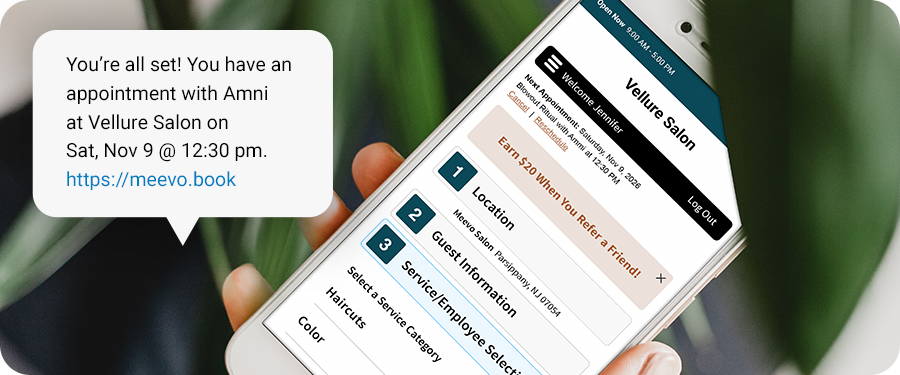
Online booking is no longer optional. It is how modern clients expect to interact with you.
Recent industry research shows:
- Around 70% of salon and spa customers prefer online booking over calling in, according to several booking studies.
- Nearly half of beauty and hair salon customers now book appointments outside of operating hours, which makes a 24/7 digital option critical.
- As of 2024, an estimated 78% of salons worldwide have adopted online booking systems, and mobile bookings grew by about 43% between 2021 and 2023.
That means your “front desk” is no longer a physical desk. It is your booking link.
What to look for:
- A mobile-friendly booking experience that works from your website, Google, and social channels.
- Real-time availability by provider, service, and location.
- Built-in deposits or card-on-file options to cut no-shows.
- Automatic confirmations and reminders via email or text.
If a system makes it hard for clients to book, your team will feel it later in empty gaps or confused schedules.
Client Management & Retention Tools
The real money in a salon is in repeat clients, not one-time visitors.
A 2025 beauty and wellness benchmark report found that repeat customers generate about 80% of salon and spa revenue, even though they represent only 42% of the client base. And industry education sources still point to first-time client retention averages near 35%, while advising salons to aim much higher.
Other data shows how large the gap can be:
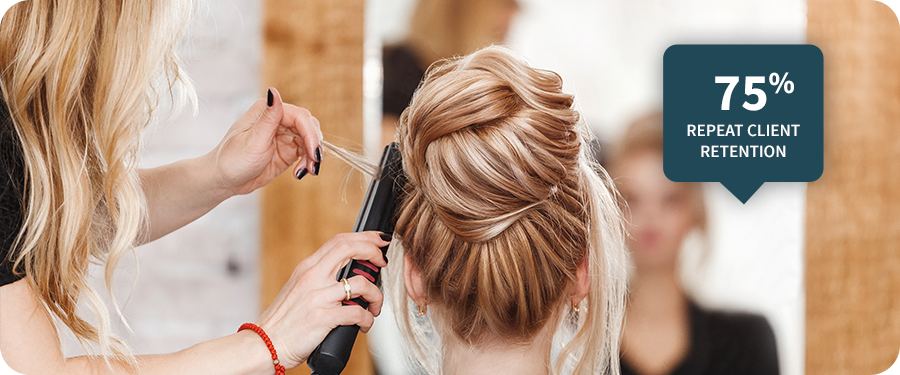
- Top-performing salons convert about 75% of first-time visits into a second appointment, while average salons convert closer to 45%.
The software you choose will either help you close this gap or keep you stuck in it.
What to look for:
- Rich client profiles with formulas, preferences, visit history, retail history, and notes.
- Automated retention campaigns (for example, reminders for color refreshes, or nudges when a guest has not visited in a set number of weeks).
- Support for memberships, packages, or pre-paid series, which lock in recurring visits and revenue.
- Segmented marketing lists (new clients, VIPs, at-risk clients, frequent cancelers, etc.) so every message is targeted.
Pro tip: Ask each vendor how their system measures new client retention, repeat client retention, and visit frequency. If they cannot show these numbers clearly, your ability to improve them will be limited.
Payments & Point of Sale That Support Profit, Not Just Checkout
Your point of sale is where the experience ends for the guest but where the data begins for you.
Most industry sources put average hair salon profit margins around 8%, while high-performing salons aim closer to 10–15%. With margins that thin, you cannot afford messy or incomplete data at checkout.
What to look for:
- Integrated payments and POS that capture services, tips, and retail in one place.
- Support for contactless payments and mobile wallets, which many clients now expect.
- Clear, transparent processing fees and next-day funding options.
- Reporting that gives you profit visibility by service type, provider, and location, not just total sales.
When your payments and booking systems are unified, you can see the full picture: where revenue comes from, who is driving it, and where it may be leaking.
Scheduling & Staff Productivity
Profit is directly tied to how well you fill the book and how efficiently your team can work.
We already know the average margin is only around 8%; a few extra productive hours per week per stylist can make the difference between “just getting by” and healthy profit.
What to look for:
- Smart scheduling that supports color timing, processing gaps, and assistants without chaos.
- Rules for double-booking, blocked times, and resources so you avoid overpromising.
- Utilization reporting that shows how booked each provider is and at what ticket averages.
- Role-based logins so owners, managers, stylists, and front desk each see what they need.
A strong system helps you balance the schedule so guests are served quickly, high-value services get prime time, and your team’s workload is sustainable.
Marketing, Communication & Reputation
2025 consumer research shows that 73% of guests say they are more loyal to salons and spas that make booking and communication simple, and that 81% of clients try to contact the business outside normal hours.
That means two things:
- Your marketing tools need to keep you visible and responsive.
- Your software has to make that communication easy, not add more manual work.
What to look for:
- Built-in or integrated email and SMS marketing with templates for promotions, rebooking reminders, and client education.
- Automated review prompts after visits and an easy way to respond.
- Tools that sync with your online presence (Google Business Profile, social links, or booking widgets).
You are not just buying a calendar; you’re choosing the system that shapes how your brand shows up online and how often clients hear from you.
Multi-Location & Growth-Ready Features
Even if you operate a single location today, the software you pick in 2026 should not box you in.
Multi-location or growth-minded salons should look for:
- Centralized reporting across all locations.
- A shared client database with location-specific visibility where appropriate.
- Consistent service menus and pricing, with flexibility for local differences.
- Tools for cross-location promotions, gift cards, and memberships.
If your current system cannot support a second or third location without starting over, that is a risk. Re-platforming on the eve of expansion is one of the most stressful times to switch software.
Step 3: Use a Simple Vendor Evaluation Checklist
Even if you have a shortlist, it’s still easy to get overwhelmed by demos and promises. A structured checklist will keep you grounded.
You can score each vendor (1–5) on the following:
1. Online Booking Experience
- Is it intuitive on mobile?
- How many steps does a new guest have to take?
2. Client Management & Retention Tools
- Can you clearly see new vs. repeat clients, visit frequency, and retention rates?
- Are there built-in automations or will you have to bolt on separate tools?
3. Payments & POS
- Are payments integrated?
- How transparent are the fees and funding timelines?
4. Scheduling & Staff Workflow
- Can the system support how your team actually works today?
- How easy is it to adjust schedules or handle complex color services?
5. Marketing & Reputation Tools
- Does the system support email/SMS, review requests, and targeted campaigns?
- How easily can you segment your audience?
6. Reporting & Analytics
- Can you quickly answer questions like “Who are my top five providers by profit?”
- Are reports understandable without exporting everything to a spreadsheet?
7. Implementation, Training & Support
- How is data migration handled?
- What training is provided for new hires?
- What do support hours and response times look like?
This evaluation should not just be done by the owner. Involve at least one manager and a couple of frontline team members so you can see how the system feels from different perspectives.
Step 4: Avoid the Most Common Buying Mistakes
Many salons end up unhappy with their software, not because they picked a “bad” product, but because they fell into these traps:
Mistake 1: Shopping on Price Alone
A low monthly fee can be tempting, but if the system does not help you increase bookings, improve retention, or get clear on your numbers, the hidden cost is much higher. With margins around 8%, a small improvement in repeat visits or average ticket can easily outweigh a higher subscription price.
Mistake 2: Confusing “All-In-One” with “Good at the Essentials”
Some platforms list every feature imaginable yet still struggle with the basics: accurate booking, smooth checkout, and usable reporting. In 2026, the essentials still matter most.
Mistake 3: Ignoring Staff Adoption
If your stylists and front desk team find the software confusing, they will work around it, skip fields, or keep their own notes on the side. That leads to bad data and poor guest experiences.
Mistake 4: Underestimating Reporting and Data
Without clear metrics, you are guessing. Many education resources note that salons should aim for new client retention rates of at least 50%, and overall retention in the 60–70% range. If you cannot measure these numbers in your system, it is almost impossible to improve them.
Mistake 5: Staying Put Because Switching Feels Scary
Moving software is a project. It requires planning, data migration, and training. But staying inside a system that cannot support your goals for another three to five years can be far more costly than a one-time switch.
Step 5: Build a Quick Scorecard & Compare
To make a final decision, create a simple scorecard for each vendor with the categories above and rate them on a 1–5 scale. You can also add weighted importance. For example:
- Online booking and client experience: 25%
- Retention and marketing tools: 25%
- Reporting and profit visibility: 20%
- Scheduling and staff workflow: 15%
- Implementation and support: 15%
This turns your decision away from “Who has the best demo?” and toward “Who best supports the outcomes we care about?”
Step 6: Recognize When It’s Time to Switch
Sometimes you suspect your current system is holding you back but you don’t have proof. Here are concrete signs:
1. Most bookings still happen by phone, and your team spends large portions of the day calling clients back.
2. You cannot quickly answer questions like:
- “What is our new client retention rate?”
- “Who are our top five revenue drivers?”
- “Which services are actually the most profitable?”
3. You rely on spreadsheets or separate tools for marketing, reporting, and payments.
4. Front desk and stylists complain about the system or consistently make mistakes in it.
5. You have no way to track how online booking affects repeat visits, even though data shows clients who book online are often about twice as likely to return for second and third appointments compared to walk-ins.
If these sound familiar, it may be time to treat a software change not as a hassle, but as a lever for growth.
Let the Demo Decide
As you move into 2026, choosing salon management software is one of the most important business decisions you will make. The right system should:
- Make it easy for clients to book whenever and however they prefer.
- Help you keep more of the clients you already earn.
- Give you a clear picture of your revenue, profit, and team performance.
- Support your growth, whether that means a bigger team, more chairs, or more locations.
The best next step is simple:
- List the outcomes you want from your software in the next year.
- Use the feature and checklist sections above to evaluate your current system and any new vendors.
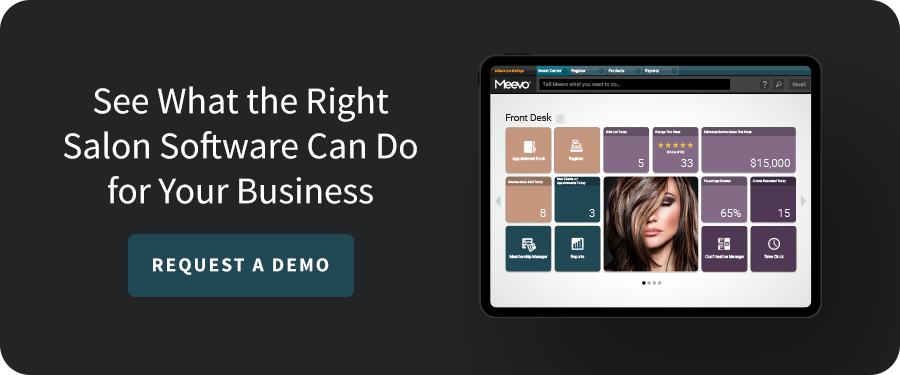
- Click the banner below to schedule a demo to see what Meevo can offer your salon.