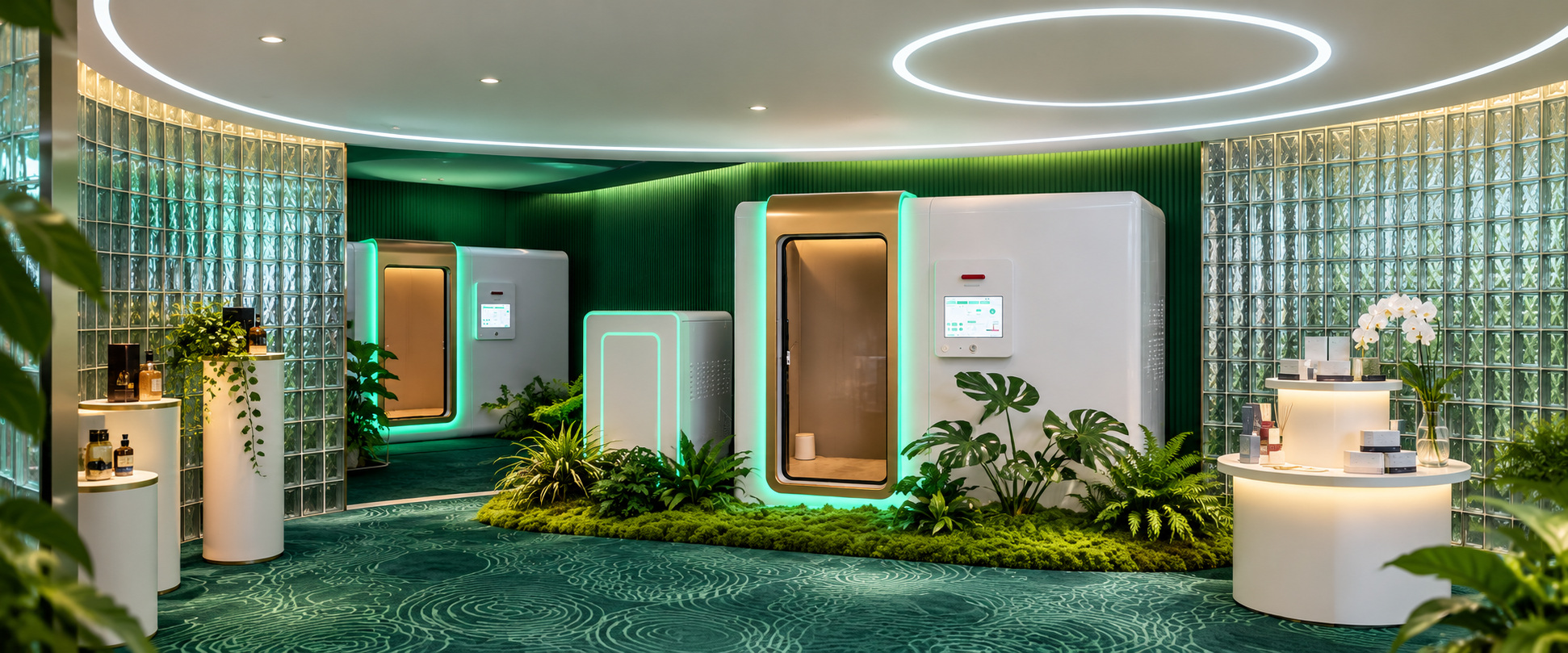
For medical spa owners, wellness center operators, and recovery studio entrepreneurs, adding a new service is one of the most important decisions in growing a business.
Purchasing equipment is not only about expanding a service menu. The investment must create enough demand, repeat visits, appointment utilization, and operating contribution to justify its cost.
According to the International SPA Association, U.S. spa industry revenue reached $23.5 billion in 2025, with 191 million annual spa visits. As competition increases, wellness businesses are exploring equipment that can differentiate their services and create additional revenue opportunities.
One category worth examining is the commercial hard-shell hyperbaric chamber. Two completed Oxycron projects—an OXY-30 Duo at a Thailand wellness center and an OXY-35 at a Singapore private clinic—offer useful examples of how chamber capacity, available space, workflow, and support requirements can shape an equipment decision.
The bigger business question is this: Can a hyperbaric chamber generate enough revenue to justify its initial investment?
TL;DR: Under the hypothetical assumptions in this article, a two-person chamber could support up to 132 paid visits and $13,200 in monthly gross revenue at full seat utilization. Actual results depend on demand, pricing, staffing, operating costs, local requirements, and how consistently both seats are booked.
This article discusses commercial wellness equipment and business planning. It does not describe medical-grade HBOT, provide medical advice, or make treatment claims.
1. Why Are Wellness Centers Investing in New Equipment?
New equipment can give wellness businesses another bookable service, raise average customer spending, and improve the use of available space. The opportunity is attractive, but only when expected demand and operating costs support the investment.
Traditional spas have long relied on massages, facials, and other appointment-based services. Modern wellness centers and recovery studios may also offer red light sessions, saunas, cold immersion, and compression recovery.
For operators, adding a new service category can create several opportunities:
- Additional revenue streams: Introduce another independently bookable service.
- Higher average customer spending: Give customers more options during a visit.
- Membership opportunities: Develop recurring service packages.
- Competitive differentiation: Create a distinctive wellness environment.
- Improved facility utilization: Generate revenue from dedicated rooms or unused operating capacity.
Commercial hyperbaric chambers are being considered by some operators as part of this broader wellness equipment strategy. However, a chamber is a specialized investment. Its potential depends on customer demand, operating costs, staffing, insurance, local requirements, and the equipment’s documented intended use.
2. What Happened at the Thailand Wellness Center?
A commercial wellness center in Thailand incorporated an OXY-30 Duo two-person hard-shell chamber supplied by Oxycron. The project demonstrates equipment planning and integration; it is not a published revenue success story.
The operator wanted a system that could accommodate two users in the same chamber while fitting into its existing wellness environment. Before purchasing, the center evaluated available floor space, doorway dimensions, chamber capacity, daily operating requirements, and long-term technical support.
The two-person configuration was relevant because it offered the possibility of accommodating two clients during the same appointment cycle.
From International Delivery to Installation
According to the published project details, Oxycron arranged DDP door-to-door delivery to Thailand, including international shipping, customs clearance, and import-related charges.
After delivery, the customer hired local workers to assemble the chamber using installation videos supplied by the manufacturer. Technical staff remained available remotely throughout the installation process.
The customer subsequently reported that staff learned the operating process quickly and that clients regularly asked about the chamber. That feedback is encouraging from an operational perspective, but it should not be interpreted as verified financial performance.
Readers can review the installation photographs, equipment configuration, and customer feedback in the Thailand wellness center chamber case study.
3. What Does the OXY-35 Singapore Project Add?
A second Oxycron project involved two OXY-35 hard-shell chambers installed at a private clinic in Singapore. The setting differs from the Thailand wellness center, so the project should not be treated as a direct revenue comparison. It is useful because it highlights another side of equipment planning: selecting a compact configuration that fits an existing room and staff workflow.
Before the purchase, the clinic and supplier reviewed installation space, intended use, daily operation, routine maintenance, and long-term technical support by video consultation. The clinic then selected the OXY-35 configuration after considering pressure stability, operating requirements, and the support available after delivery.
Remote installation guidance and operating instructions were provided during setup. According to the project page, the completed chambers were integrated into the clinic’s appointment environment after the team had addressed room access, startup procedures, routine checks, and maintenance questions.
The OXY-35 Singapore project reinforces an important business lesson: the best configuration is not always the largest. A chamber must fit the available space, operating workflow, expected demand, and support plan. Because the project is clinic-based, readers should also avoid assuming that its operating model or requirements automatically apply to a non-medical wellness center.
4. How Much Revenue Could a Two-Person Chamber Generate?
The revenue potential of a two-person chamber depends primarily on the realized price per occupied seat, the number of appointment cycles offered, and the percentage of available seats that are actually booked.
Consider a hypothetical wellness center operating one two-person chamber under the following assumptions:
- Average realized price per occupied seat: $100
- Available seats per appointment cycle: 2
- Complete appointment cycles per day: 3
- Operating days per month: 22
At full utilization, this produces a theoretical monthly capacity of:
2 seats × 3 cycles × 22 days = 132 client visits
Most businesses cannot assume 100% occupancy. The following table shows how seat utilization changes hypothetical monthly gross revenue.
| Seat Utilization | Monthly Client Visits | Monthly Revenue |
|---|---|---|
| 25% | 33 | $3,300 |
| 50% | 66 | $6,600 |
| 75% | 99 | $9,900 |
| 100% | 132 | $13,200 |
These figures are hypothetical and do not represent actual revenue from the Thailand project. The $100 price is an illustrative assumption, not a verified market average or recommended fee.
Actual pricing will vary based on location, competition, session format, customer demand, and applicable local requirements. A two-person chamber also does not automatically generate twice the revenue of a single-person chamber. Both seats must be occupied by eligible paying customers, and the operating model must support the proposed scheduling arrangement.
5. What Is the Difference Between Revenue and Profit?
Gross revenue does not show what a new service actually contributes to the business. Operators also need to subtract variable costs and the additional fixed expenses required to offer the service.
For illustration, assume:
- Variable operating cost per client visit: $20
- Additional fixed operating expenses: $3,000 per month
Under those assumptions, the potential monthly operating contribution would be:
| Utilization | Monthly Revenue | Operating Contribution |
|---|---|---|
| 25% | $3,300 | -$360 |
| 50% | $6,600 | $2,280 |
| 75% | $9,900 | $4,920 |
Operating contribution is calculated after deducting the specified variable costs and monthly fixed expenses. It is not the same as net profit.
The figures may exclude depreciation, financing costs, taxes, unallocated overhead, additional marketing, and other facility-specific expenses. This is why med spa owners should track equipment and service performance alongside other med spa KPIs.
The lesson is straightforward: Equipment utilization can matter more than the headline price charged per session. An expensive service with few bookings can contribute less than a moderately priced service with consistent demand.
6. How Long Could It Take the Chamber to Pay for Itself?
A simple payback calculation divides the all-in initial investment by the monthly operating contribution. It is a useful planning estimate, but it is not a complete return-on-investment analysis.
For this example, assume an all-in initial investment of $40,000. This hypothetical planning budget covers equipment acquisition, shipping, setup, and initial facility preparation. It is not a manufacturer quotation or a confirmed cost of the Thailand installation. Buyers can review Oxycron’s indicative chamber price ranges and configuration factors separately before requesting a project-specific quotation.
| Seat Utilization | Monthly Operating Contribution | Estimated Simple Payback |
|---|---|---|
| 25% | -$360 | No payback at this operating level |
| 50% | $2,280 | Approximately 18 months |
| 75% | $4,920 | Approximately 8 months |
The simplified calculation is:
Initial investment ÷ monthly operating contribution = simple payback period
At 50% utilization, $40,000 ÷ $2,280 is approximately 17.5 months. At 75% utilization, $40,000 ÷ $4,920 is approximately 8.1 months.
These are scenario calculations, not promised returns. Actual payback may be substantially longer because of startup delays, utilization fluctuations, financing charges, maintenance, insurance, facility changes, and other costs. A business should complete a detailed cash-flow analysis before purchasing.
7. How Can a Wellness Center Improve Service Revenue?
Equipment does not become profitable simply because it has been installed. The business needs a practical plan for pricing, packaging, scheduling, and retention while keeping its marketing and operations aligned with the equipment’s intended wellness use.
Offer Multi-Session Packages
Where permitted and appropriate, businesses may offer single appointments alongside packages of five or ten sessions. Packages can make scheduling more convenient and improve revenue predictability, but any discount should be calculated carefully to protect margins.
Introduce Membership Options
Membership programs can create more consistent customer engagement. A wellness center might develop a premium membership covering several separately delivered services, provided each service fits the customer and complies with local requirements.
Recurring arrangements also help operators forecast bookings and allocate staff. Integrated membership management tools can simplify recurring billing, package balances, and usage tracking.
Combine Complementary Wellness Services
Centers offering multiple services may develop broader packages involving separately delivered red light sessions, sauna experiences, or other wellness amenities. The objective is to give customers more choices and increase average transaction value—not to imply unproven therapeutic benefits from combined services.
Improve Appointment and Yield Management
For a two-person chamber, seat utilization is especially important. Operators should monitor:
- Booked versus available seats
- Appointment cancellations and no-shows
- Revenue per appointment cycle
- Customer retention and package usage
- Operating costs per session
These indicators help managers see whether the investment is performing as expected. They also support the broader goal of improving med spa revenue and profit margins through better service-level decisions.
8. What Should Buyers Know About the Manufacturer?
The Thailand project was published by Oxycron, which describes itself as a factory-direct chamber manufacturer rather than a conventional equipment reseller. Because these statements come from the supplier, buyers should verify all product, safety, certification, and support claims independently.
According to its company information, Oxycron provides manufacturing, product customization, quality inspection, and international project support. The company also offers OEM and ODM services for commercial buyers.
Working directly with a manufacturer may offer several practical advantages:
Factory-Direct Communication
Buyers may be able to discuss specifications, production arrangements, available configurations, and technical questions directly with the manufacturer.
Customization Options
Depending on the model, customization may include chamber configuration, interior finishes, branding, and selected features. For high-end wellness centers, those choices can help the equipment fit the facility’s overall design.
International Delivery Support
The Thailand case illustrates the supplier’s ability to coordinate international transportation and import-related logistics for one specific customer project.
Installation and After-Sales Assistance
The company states that it provides installation guidance, operating videos, spare-parts support, and remote technical communication.
Factory-direct sourcing does not automatically establish regulatory suitability, superior safety, or lower total ownership costs. Buyers should request complete written quotations and independently verify the documentation relevant to their location and intended use.
9. What Should Wellness Operators Verify Before Investing?
A non-medical wellness chamber still requires careful due diligence. Operators should verify the exact equipment’s documented intended use, installation requirements, operating limits, safety procedures, and suitability for the proposed commercial setting.
Before committing to a purchase, review:
- Product documentation: Obtain model-specific specifications, operating instructions, test records, and applicable certifications.
- Local requirements: Check building, fire, electrical, pressure-equipment, occupancy, and business rules that may apply.
- Facility compatibility: Confirm room dimensions, access routes, ventilation, floor loading, utilities, and emergency procedures.
- Insurance: Ask the facility’s insurer whether the proposed service and equipment are covered.
- Staff procedures: Establish training, supervision, cleaning, inspection, maintenance, and incident-response processes.
- Marketing language: Avoid medical or disease-treatment claims when the equipment and service are positioned for non-medical wellness use.
Operators should obtain product-specific documentation and consult qualified local professionals when questions involve safety, code compliance, insurance, or the boundary between wellness and medical services.
10. Is a Two-Person Chamber Right for Every Wellness Center?
No. A two-person chamber is most practical when a facility has adequate space, sufficient expected demand, and a service model that can use both seats consistently.
Larger equipment can introduce additional transportation, access, installation, utility, and floor-loading costs. For facilities with limited space or uncertain demand, a smaller configuration may be more practical.
The decision depends on target customers, available space, financial capacity, local requirements, and expected utilization. The Thailand project is one example of facility planning and equipment integration—not proof of guaranteed financial returns.
Frequently Asked Questions
Can a hyperbaric chamber increase med spa revenue?
It can create another bookable service, but revenue depends on price, appointment capacity, and utilization. In the hypothetical model above, monthly gross revenue ranges from $3,300 at 25% utilization to $13,200 at full utilization. These figures are scenarios, not expected or guaranteed results.
Does a two-person chamber automatically earn twice as much?
No. Both seats must be booked by paying customers during the same appointment cycle. If demand is inconsistent or customers prefer private sessions, the second seat may remain unused and the revenue advantage can disappear.
What costs should be included in an ROI calculation?
Include equipment, shipping, import charges, installation, facility preparation, utilities, staff time, maintenance, cleaning, insurance, financing, marketing, and expected downtime. A simple payback calculation is useful, but a detailed cash-flow forecast gives a more realistic picture.
Is this article discussing medical-grade HBOT?
No. This article focuses on a commercial chamber positioned for non-medical wellness and recovery settings. Operators should avoid medical treatment claims and verify the product’s documented intended use, local requirements, and appropriate operating procedures before offering a service.
Final Thoughts: Treat the Chamber as a Business Investment
For medical spas, wellness centers, and recovery studios, a commercial hyperbaric chamber may create another service category and an additional source of revenue. Long-term profitability, however, depends on demand, pricing, utilization, operating efficiency, appropriate positioning, and reliable support.
The Thailand wellness center case highlights the planning involved in selecting, delivering, and installing a two-person chamber. It also shows why operators should look beyond the purchase price and evaluate space, logistics, training, documentation, and after-sales support.
For businesses considering a similar investment, the best starting point is a realistic financial model and a thorough review of the equipment and operating requirements. Operators can also request a project-specific chamber quotation using their room dimensions, location, preferred capacity, and installation requirements. Med spa management software can then help the business track bookings, packages, utilization, and service performance after launch.
The most profitable option is not necessarily the most or least expensive chamber. It is the one that fits the facility’s operational needs, local requirements, and sustainable customer demand.
Sources and Further Reading
- International SPA Association — 2026 Industry Statistics
- Oxycron — Thailand Wellness Center Installation
- Oxycron — Singapore Private Clinic Installation
- Oxycron — About the Manufacturer
Editorial disclosure: This article includes information about Oxycron and a project published by the company. Revenue and payback calculations are hypothetical and do not represent verified customer financial results. The article discusses non-medical wellness equipment and does not provide medical or financial advice.